Income Ally
Sign in →
Alongside your tenants · Behind your income team

Stay human. Stay compliant.

A team that knows nothing about a tenant cannot treat them fairly. A team that cannot show what it did cannot defend the case.

Sign in
The person, not just the balance Where the law says stop, it stops Your rules, your thresholds, your words

Why both words matter

Empathy and legality are the same job

Stay human

The case opens with the person, not the balance.

  • Their payment rhythm, not a weekly batch. Derived from how they actually pay.
  • Adjustments enforced, not displayed. A recorded need changes what you can send.
  • Life disruption on the case. A bereavement or benefit delay, visible before you call.
  • Cases that resolve close themselves. Somebody paying again is not somebody to chase.

The honest version: we can evidence your work and stop you chasing where the law says stop. We cannot make the judgement call for you.

About Income Ally

One place to work arrears, and to know when not to

1

It works the way your team works

Rules, thresholds, the words on your buttons and who sees which page, configured by your own admins.

2

It knows when to stop

A moratorium, an insolvency order, a live complaint, a debt past six years. Each suppresses chasing in the database, not on the screen.

3

It knows the person

Household, income, vulnerabilities and communication needs, in front of the officer before they write a word.

4

It shows you the whole book

What nobody has touched, and how much you are correctly declining to chase. By officer, by patch, by team.

Who it’s for

Seven people ask seven different questions about the same thing

Rent is the income a housing association actually controls, and it funds everything else. That makes arrears a finance question, an operational question, a customer question and a regulatory question at the same time — asked by different people, who need different answers.

How it runs a day

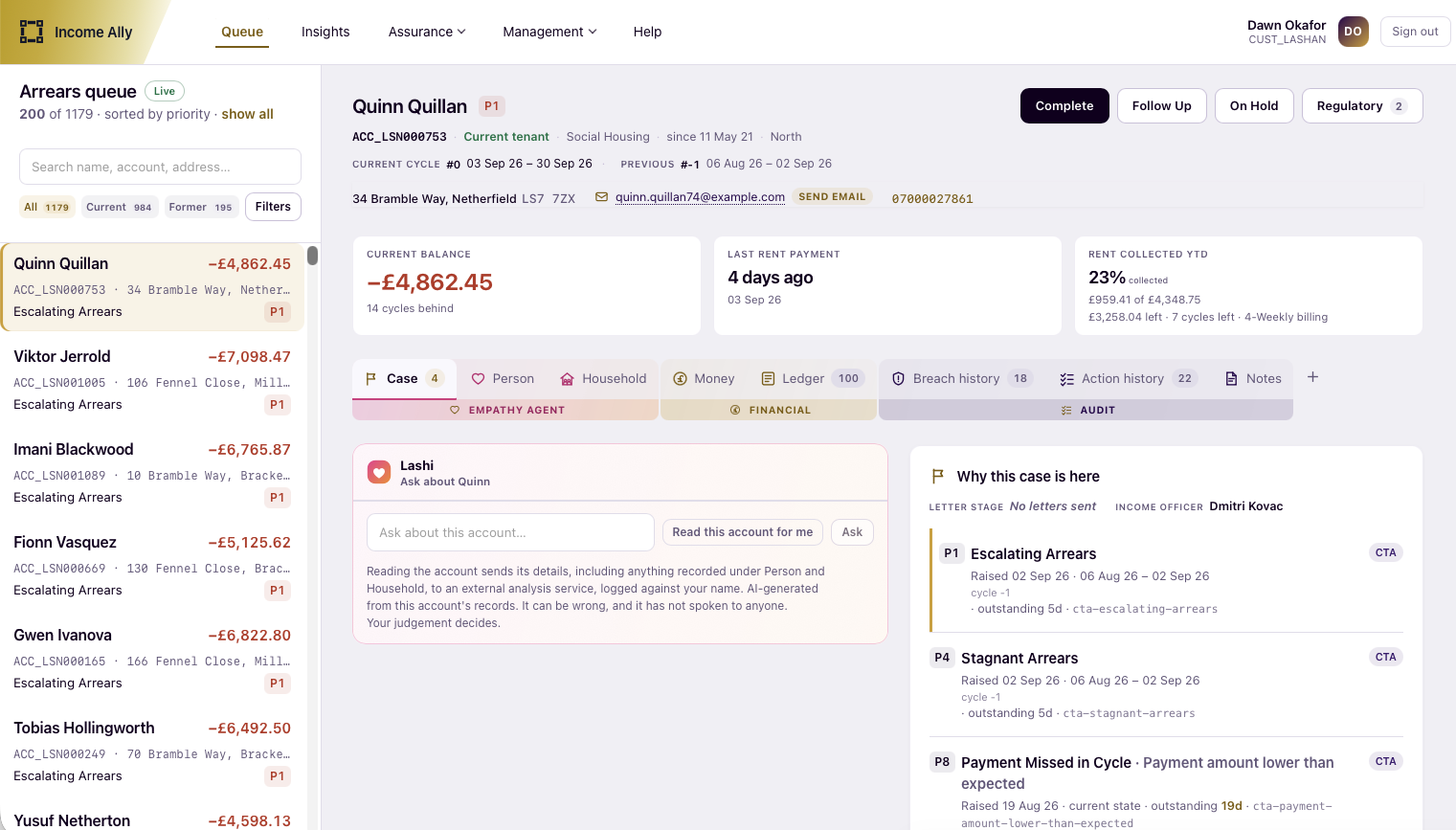
The queue is built overnight, and it explains itself

Nothing in the worklist is put there by a person. Every case says why it is there, and the date that reason was assessed.

→

Cases raise themselves

Escalating arrears, a missed payment in a cycle, a broken arrangement, a former tenant approaching the end of the clock. Each is a rule you can read, change, or switch off.

→

Cases close themselves

When the reason a case exists stops being true, it closes itself and records why. No officer works a case on a reason that no longer applies, and nobody has to tidy up the queue by hand.

→

Cases refuse to be chased

Record a moratorium and the case leaves the queue, the overnight email will not go out, and the send button refuses, and it comes back on its own when the period ends.

A debt and the right to chase it are two different things. Nearly every rule an income team is bound by is about when to stop, not how to collect. That distinction is the thing this product is built around, and it is the reason the same screen can show you £2.2m of arrears and tell you which £39,000 of it you must leave alone.

Income Ally capabilities

The six that are not standard

Payment cycles it works out itself

Nobody types in whether a tenant pays weekly or monthly. It is derived from how they actually pay, so "missed a payment" means missed theirs.

Rules you can read and change

Every case is raised by a rule with a threshold you own. Change a number and your cases re-evaluate immediately, not on our next release.

The empathy agent

Household, income and access needs read together, with a briefing an officer can ask questions of. It drafts for a person and decides nothing.

The limitation clock

How long is left to enforce each former-tenant debt, which date it runs from, and what restarts it. Sorted by what lapses first.

Off-limits, with the number attached

Every suppressed pound and the legal reason for it. The part of the book you are correctly leaving alone, stated as a figure.

Untouched accounts, flagged

Arrears nobody has picked up, separated from arrears somebody worked and left. Those are different problems with different answers.

The duties it enforces

Not badges. Behaviour.

Thirteen duties change what the product will and will not do, which cases appear, which are suppressed, and what the send button refuses. Three of them, as examples:

Inside a moratorium, the send refuses

Debt Respite Scheme Regulations 2020

The account leaves the queue at the queue itself, not rule by rule. One exception, deliberately: the six-year clock keeps reporting, because a statutory deadline does not pause for a moratorium.

An unread access need refuses the send

Equality Act 2010 s.20 · Pre-Action Protocol

Somebody confirms they have read how the resident needs to be contacted, and the confirmation stores what they read. It stops counting if the needs change.

Ground 8 does not exist against a secure tenant

Housing Act 1985 s.83 · Housing Act 1988 Sch 2

So the tenancy regime decides the route before the balance does, and where it is not recorded the product says the grounds cannot be stated rather than guessing one.

Every duty, and what we don't do → The full list, with the limits of each, including the two places this stops short.

The legal spine of collection

Four questions a court will ask, answered across the whole book

Not per account, after somebody opens it. Across every tenant you are chasing, tonight, with the money attached to each answer.

1

Which ground is open, and does the judge have a choice?

Housing Act 1985 s.83 · Housing Act 1988 s.8 & Sch 2

Tenants and arrears in each stage, with the threshold for each rent period stated, and for the discretionary route, which of the four things a court looks for is missing.

2

Could we satisfy the Pre-Action Protocol if we tried?

Pre-Action Protocol for Possession Claims by Social Landlords

Six requirements, evidenced or not, per current tenancy in arrears, and which requirement is your gap. Compliance is judged at the point the claim is issued, so evidence assembled afterwards is worth very little.

3

Have we had regard to who these people are?

Equality Act 2010 s.149 · Article 8 proportionality

Two figures kept apart: where a protected characteristic is recorded, and where the assessment and the adjustment offer both exist. A landlord that thought carefully and wrote nothing down stands where one that never looked stands.

4

Where must recovery stop entirely?

Debt Respite Scheme 2020 · Insolvency Act 1986 · Limitation Act 1980

Every suppressed pound with the legal reason attached, and how long is left to enforce each former-tenant debt. Not a backlog. The part of the book correctly being left alone.
Arrears and the law

Straight answers, with the statute named

Written by the people who had to wire these duties into software, which is a good way to find out where the ambiguity is. Every one answers the question first and says what we don't do about it last.

All eight answers → Plus a glossary of twenty-two terms, and twelve questions to ask any vendor — including us.

Pricing

Priced on the size of the book, not the number of seats

An income team that has to ration logins is a team working around its software. Every plan carries unlimited users, the full rule set, and both the current and former tenant books. Talk to us about your account volumes and we will put a number to it.

Pilot

One patch, one team, a fixed period

  • Your own data, loaded
  • Full rule set and admin
  • Unlimited users
  • Set up for you

Most landlords start here

Whole book

Current and former tenants, every patch

  • Everything in Pilot
  • Limitation clock and Off-limits
  • Automation and self-resolution
  • Recovery and team reporting
  • Roles and per-page access

Group

Several landlords on one deployment

  • Everything in Whole book
  • Separate rules per organisation
  • Database-enforced isolation
  • Named account manager

FAQ

Questions we are asked

Does it make us compliant?

No, and no software can. The Regulator of Social Housing regulates landlords, not products. What this does is evidence your work and decline to chase where the law says stop. Your compliance stays yours.

How much of it can we change ourselves?

The thresholds every rule measures against, whether a rule fires at all, its priority, the words on every action button, the questions asked when a case is closed, which rules email a tenant instead of queueing a case, the documents the assistant answers from, and what each role may reach page by page. All of it from the Admin panel, by your own people.

Do tenants see any of this?

No. Income Ally has no tenant-facing interface. Everything in it is for the landlord's own team, which is also why every decision it surfaces is recorded against a named officer rather than against the system.

Is the AI making decisions about people?

No. Rules decide what goes in front of an officer, and a named person decides what to do. Every figure on screen is computed from the ledger, never generated. The one place text is written rather than calculated is the suggested approach panel, and that panel says on screen that it is AI-generated, that it can be wrong, and that your judgement decides.

What does it need from us to start?

Eight flat extracts from your housing management system: accounts, transactions, rent values, arrangements, benefit data, tenants, properties and officers. We publish the exact columns and coded values we expect, including which ones decide whether an implementation is right rather than merely finished.

Start with the book you already have

Most teams begin with one patch and their real ledger, so the first thing they see is their own arrears in their own payment rhythms. Tell us about your organisation and we will set it up.

Sign in